Flights, First Impressions, and Faulty Connections

One journey, eight months in the making, is finally over, while another, not yet two days old, has only just begun. Since learning about my acceptance into the Shansi program late last November, I have finally taken the plunge to living in rural China. It was preceded by two intense, emotional, incredible, and trepidation-filled weeks at home with some of my closest friends—a great way for me to stock up on memories like rations to fuel these long two years away from the people I love most.

The trip itself went smoother than I had anticipated. Being a little too literal in my attempt to follow my first piece of advice about arriving in China—don’t come with any preconceived expectations—I didn’t bother to check my flight length, nor the time difference between Beijing and New York (it’s a wonder I got to the right airport, no?). But it was a pleasant surprise—the flight was a little over thirteen hours, four of which I spent watching movies (The Devil Wears Prada and The Matrix, both with Chinese subtitles), and barring time eating or using the bathroom, the other nine I spent asleep. In something of a miscue, at least based upon all of my previous air travel experience, I actually befriended a fellow passenger (Yitka would be so proud!). The woman next to me was the mother of a recent high school grad, and was very quick to talk about the economic climate and its affect on this year’s crop of giddy college-goers. She made an interesting point—new college-bound students are less willing than their predecessors to “follow their passions”—unless those passions just happen to be in medicine, law, or finance. Out of practicality for the possibility of finding work after graduation, many are looking toward future job placement as a motivating factor both for their choice of major and their choice of college. She insinuated that application numbers for private colleges are down, suggesting that many students are worried about not being able to pay back expensive loans after graduation and are instead looking at specialized programs in public or trade schools.

This certainly had its implications for me and my fellow graduates. Much to everyone’s surprise, the Class of 2009 found not a diploma within the fancy binding handed out at Commencement, but a bill for four years of faux-preparation for the job market. I was of a relatively few, fortunate bunch who were able to get something going after graduation. It was so disheartening to see dozens of my friends completely strapped for any semblance of employment, spending the summer cooped up in a parent’s house or an apartment that they could scarcely afford. I realized over the course of this conversation en route to Beijing that had I been entering college and not the “real world” this coming September, I would probably find myself in the same boat. There’s little chance I would have stuck with Creative Writing as a major—opting instead perhaps to follow my first passion (engineering) and if I did study language, have done so more out of utility than simple curiosity. I’m glad though that the economic downturn did hold off until it did, and that I was able to pursue the interests that have carried me to China, but that’s not to say that I still won’t inevitably have to put them on the back burner upon returning full time to the states.

In any case, the flight itself was mercifully forgiving, and customs and immigration went off without a hitch. I bid farewell to my new acquaintance and took a short shuttle bus to another section of the airport where I again went through customs and check-in for my domestic flight to Taiyuan. In the three-hour layover, I succeeded in staying awake despite a 4am timestamp. I bought myself an iced tea, curled up with a Chinese newspaper, and listened intermittently to a newscast—reveling in my utter inadequacy. As suspected, and in a complete “déjà vu moment” of my domestic flight from Tokyo to Osaka two years ago, I was unconscious for the flight’s entirety. It wasn’t until the seatbelt lights went off and the passengers next to me started getting restless that I realized we had not only left Beijing, but we had already arrived at our destination.

The front of my house. Apparently, we Shansi Fellows are experts in all things foreign.

I was greeted at the airport by Li Sen, one of the officials of the Foreign Language Program at Shanxi Agricultural University where I will be teaching. With his arrival came my first of two tests. After standing at the baggage claim for well over twenty minutes and watching scores of passengers from later flights retrieve their last suitcases, I finally conceded that my bags were not going to emerge in Moses-parting-the-Red-Sea fashion from the rubber birth canal. I proceeded to confront an airline official and successfully communicated my predicament in Chinese. She sat me down in a badly ventilated gray hull of a room to exchange pleasantries with some of the other airline officials as she went to investigate. They showed up intermittently, almost always preceded by a smile or a giggle, as if only to catch a glimpse of the delusional foreigner who claimed to be living in China’s backwaters for the next two years.

After I was sufficiently grilled by the airline's staff, she returned to tell me that my bags were located in Beijing and that they would be delivered to the post office at the school’s campus the following morning. Greatly relieved, I thanked the woman and went to join Li Sen and the driver out in the parking lot. It was raining outside, and when I asked if this was common in Taiyuan, Li Sen said simply: “only when we’re picking up foreigners.” We drove to a nearby restaurant to have dinner and kill some time before we were to pick up Nick, one of the two senior Fellows, who was to be arriving from Shanghai that evening. It was at the restaurant (or rather, just outside of it) where I faced my second test: navigating the squat toilet in an outhouse whose corrugated tin roof was only partially effective in keeping out the biblical rains. After returning inside, we ate, sharing many small dishes between the three of us—our chopsticks jabbing and poking at Kung Pao Chicken (the go-to dish for newly-arrived foreigners), wood ear mushroom, cabbage, and tofu. Conversation was directed almost solely through Li Sen, as the driver didn’t speak a word of English and I was still too nervous to try out my Chinese in any large capacity.

After we got word that Nick’s flight would be delayed for at least a few more hours, we drove the 40 minutes from Taiyuan to Taigu and before I knew it, I was handed a pair of keys and situated neatly at my house for the next two years. Anne, the other of the two senior Fellows, having arrived a day earlier, came to greet me with her friend Lynn, a former student and current friend. We spent a lot of time talking and getting caught up on each other’s lives. As fate would have it, I had actually taken classes with both Nick and Anne at Oberlin but I didn’t know either of them very well. God knows that after a year here together with scarcely any other foreigners, that situation will change very quickly. As it was, I learned a lot about her last year in Taigu, the ups, the downs, the challenges, and the triumphs. Of course, I inevitably unloaded a bunch of my own fears, excitements, and the usual slew of “what’s,” “how’s,” and “what-have-you’s,” which she fielded graciously. We took a tour of the place, with Anne stopping to “reclaim” some of the odds-and-ends along the way.

My incredibly luxurious bedroom in Taigu.

The house itself is almost shockingly nice. Before arriving, I shuttered to imagine how my living situation might be, but I have been pleasantly surprised in almost every aspect. As far as the houses in Taigu go, those on the campus of Shanxi Agricultural University rank highly, and as far as those go, the foreign teacher houses surely rank among the best. I share a house with another first-year Fellow named James, a fellow New Yorker who graduated from Oberlin two years ago. In our house we share a living room, and have our own separate bedroom, bathroom, and kitchen. The bedrooms are very spacious, with room for a queen-sized bed, two closets for hanging clothes, a dresser, a couple of night-stands, a large desk, a bookshelf, a few lamps, a telephone, and a personal heater. The bedroom alone is about the size of my room at Oberlin my senior year.

The kitchen is also quite large and is equipped with a fridge, microwave, laundry machine, hot plate, and yes, a rice cooker. Luckily for me, the cupboards are already stocked with some dry food, bowls, cups, utensils, and other supplies from previous Fellows. Unlike many other places in China, our bathrooms are outfitted with an actual toilet, in addition to a hot water heater for the shower. These small comforts I certainly took for granted both in Japan and back home, but in China, luxuries like these are hard to come by. I have heard stories about Fellows using their bathrooms before and after going just about anywhere because the public options in other places—even in school buildings and student dorm rooms—are less than ideal. As a reference point, I have heard that the student dorms on campus are much shabbier in comparison. In the span of our bedrooms, the college typically crams between three (if you are a grad student) and six (if you are an undergrad) Chinese students. It’s incredibly strange to be in a place where by virtue of our American-ness alone we are afforded so much privilege, and how spoiled we are to be foreign teachers on this campus. However, it is a small comfort to know at least that the Chinese teachers at this university have living arrangements similar to our own.

My shared living room. The disco ball and the huge speakers are remnants of Ben and Beth's (the previous two Fellows) famed dance parties that took place in the house last year.

The living room is truly the nexus of the house. There is a bookshelf stocked with teaching materials and other books left behind by the Fellows—some good and some less than enticing. The TV picks up all of the Chinese stations and even has a VCR—gasp!—as well as a bunch of old movies that we have to work with. There are also a couple of bikes that have been passed down from older generations of Shansi Fellows—some way to commute to town easily and also go adventuring in the nearby mountains. If there’s anything that worries me about the house, though, it’s the winter. It gets pretty cold up here, and sometimes it’s a while before the heat gets turned on. Especially in the winter, Anne and Nick have also talked about there being mice, which, for lack of a better solution, the Foreign Affairs Office has remedied by putting a cat in their house. Their cat is named Mumu, and actually gave birth to four kittens last year, one of which, Boots, also lives in the house. James is allergic to cats, so we won’t be getting one in ours, but hopefully we’ll find some way to deal with that when the time comes.

By the end of my first evening in Taigu, Nick had arrived from the Taiyuan airport. The three of us continued to chat and reminisce well into the night, helping both with recalibrating my body from the jetlag and discovering more about my new environment. We migrated from my house to Nick and Anne's, almost identically furnished (save for a few more lived-in items), and located just a stone's throw away. It sounded like they both had amazing summers, traveling and seeing friends (including some of the other Shansi Fellows) in the long two months off. There’s a lot more about this place that I have learned and experienced since, and thanks in no small part to Nick, I have finally been able to successfully access both the internet and this site. It took about two weeks for the internet to start working here, and combined with general Chinese censorship restrictions, simply being able to post on Blogger has been no small project. But my first impressions of China have been great so far, and I’m so excited to begin teaching and learning more about the university and the people who will populate my new life abroad.
Living Paycheck to Ticket Stub

Old habits are truly hard to break. Ever since middle school, it’s been the same story—I have always taken on more than I need to or is wise for reasons that continually elude me. In high school, I took roughly double the number of classes I needed to graduate, eventually depriving myself of adequate time in my schedule to go to lunch in between class periods. Going to Oberlin only seemed to exacerbate the problem. I could have graduated a semester early despite enrolling with only 4 AP credits, but not only did I stay for that extra spring, I took a full course load, another 16 credits worth of classes as I had for nearly every semester before that. I rationalized it to myself well—tuition is a flat rate whether you take 12 credits a semester or 16, so I might as well make the most of it, not to mention the fact that I have a hungry curiosity and there are so many interesting classes to choose from. And that’s just the academic side—not to mention work-study jobs and extracurriculars. Like many Obies, it seems as though I had to learn time management the hard way, and it was only after I left Oberlin that I finally appreciated the concept of free time. Or at least, that was until I got antsy for something more.

Despite Chinese class being so intensive, since it was only one class, and since I had absolutely no extracurricular or work obligations at Cornell, I still felt like I had a ton of extra time. I realized that it was the academics in tandem with all of the extra stuff at Oberlin that made me so utterly insane. Stripping all of that excess away at Cornell was like shearing a sheep in the summer, despite that fact that, like sheep, I sometimes start to miss the outer sheathing that is part of who I am. I realized why this is—that doing things, perhaps too many of them at once, keeps me constantly restless, and not being content is the best way to move forward, to expect more from myself and work until I get it. If not for this, I would probably not have changed much from my high school self, which seemed to be frozen in time for the first three years. Keeping busy also gives me purpose, and allows me to sidestep the emotional nerves that perk up from time to time, which, with enough time to properly process, would completely drain me physically and creatively.

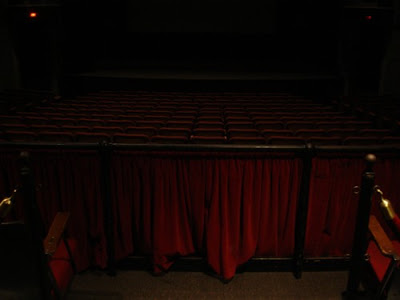
A view of the Cornell Cinema just minutes before a film screening. The usher is designated a special seat close to the exit in the back of the theater to make it more convenient to open and close the doors.

And so, seated with a flurry of free time and nothing to fill it, I went about sifting through the great ether of bulletin board listings and announcements that seemed to grow on walls like a fungus. What I overwhelmingly discovered were flyers to participate in surveys and studies. Most were sponsored by academic departments that were willing to pay volunteers to take part in their experiments, especially during the summer, when presumably, students are less busy and more in need of a disposable income. As having fit both of those criteria, I took up the offers, snatching up the little take-away information sheets with names and email addresses. At first, I was incredibly skeptical, and daresay a little nervous, but by the second week, I had already accumulated a stack of six and had my eyes set on more.

It didn’t take long before I got hooked. After the initial wave of emails were sent out, I signed up on list-serves and registered with online study databases. I was enrolled in both the Business Simulation Lab (run out of the Johnson School of Management) and Susan (sponsored by the Psychology Department), the only two active during the summer. I checked the listings every day and signed up for studies as soon as new ones became available. Pretty soon, I was pulling a handful of them a week. I participated in food studies, brainstorming sessions, olfaction experiments, and healthy aging surveys. As you might expect, some of the experiments were more engaging than others. During lunch and after class, I would disappear for minutes at a time to work through logic problems in crowded computer labs, put my nose to a gaggle of squirt bottles and test the efficacy of retronasal smelling, or decide how much money I would be willing to give to a complete stranger. Conversations with friends would inevitably revolve around comparing notes on future studies or describing how past ones went. A half hour of time was prorated at $5 an hour and an hour was upwards of $10-$15. Best of all, those were only estimates—realistically, you could complete most studies in half of the stated time. When all was said and done, I would guess that after a month I had made about $150.

With a veritable part-time job now eating up a good portion of every week, I was satisfied with the extra breathing room in my wallet for miscellaneous expenses and some costs that Shansi couldn’t cover. But the lack of extracurriculars was still wearing down on me—I wanted something I was reasonably passionate about that I could devote significant time to each week. The answer came from an unlikely source. Perusing through the usual selection of periodicals and stray publications floating around the library one day, I came across an advertisement for the Cornell Cinema. It wasn’t my first exposure to the Cinema. In the first week, I had seen a screening of the mildly terrifying Tim Burton film, Coraline, which only gave me nightmares for the first few weeks or so. Even this initial outing, I heard, though, was something of an anomaly—many of the friends I had talked to in my class had never heard of the Cinema, or if they had heard of it, had themselves never been before. My interest in the Cinema certainly didn’t come out of any experience at Oberlin. Though I very early on in my freshman year signed up on the OFS (Oberlin Film Society) email list, my involvement was limited to simply having been to a sprinkling of $1 screenings over the course of my four years. But at Cornell, given that during the summer there was nothing like AAA, TWC, or the BCSL to sink my teeth into, I figured it was as good an institution as any.

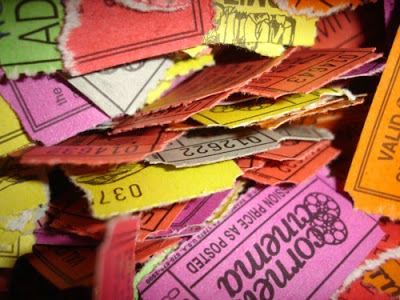
My single proudest photographic achievement, done by sticking the lens of my camera in the narrow, pitch-black opening of the ticket deposit. This must have been my tenth or eleventh attempt.

The advertisement in the paper was for an usher position, an unpaid gig, but one that came with a handful of enticing benefits. There was the boon of a free Comp Pass for two to all regular screenings at the Cinema, free popcorn and lemonade during one’s shift, and perhaps best of all, a snazzy “Cornell Cinema Staff” t-shirt. It doesn’t take a particular observant or even close friend to track my extracurricular interests at Oberlin, as almost all of them came with t-shirts that have now become the pride of my active wardrobe. In retrospect, it’s hard for me to imagine what I wouldn’t do for free, reasonably attractive apparel. In any case, I went that afternoon to the basement of Willard Straight Hall, a hulking castle of a building, which housed both the Cinema and the office where I dropped off my application. A day later, I received an email letting me know that my schedule fit well enough that on practically the basis of that alone and the fact that there weren’t presumably many other applicants, I got the job! I would be working one shift a week for my remaining six weeks at Cornell over the summer.

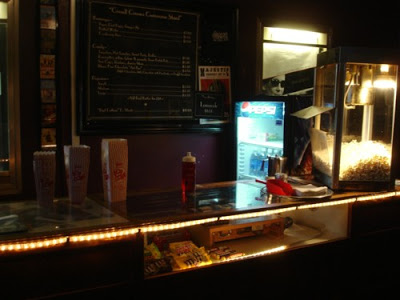
A view of the ever-engrossing Cornell Cinema concession stand.

According to its website, the Cornell Cinema has been cited as one of the best campus film programs in the country, screening close to 300 different films a year. The place was consistently well kept and the management certainly lived up to its good name. On any given shift, there were a handful of employees—the ever-critical usher, concession stand operator, ticket seller, projectionist, and house manager. Every person knew his or her exact role at any given time. As far as I was concerned, the usher duties were quite simple. They consisted largely of getting to the theater 30 minutes before show time, moving the ticket deposit from a dank closet to a convenient position in front of the entrance, ripping tickets and making small talk with patrons, watching the movie, and doing some minimal clean-up at the end. Perhaps the best part of the whole ordeal was what was called the “pre-screen,” the five minutes before doors opened when the projectionist screened the beginning of the movie to make sure that the picture was in focus and the volume was good. I was responsible for standing in back of the theater and communicating minor adjustments to the house manager, who stood on stage in the front, and then relayed those same cues to the projectionist. The sound the film reel made when the picture was deemed “thumbs up” and the screen gradually faded to a grinding halt was truly priceless.

As far of the selection of movies went, I was thoroughly pleased, not to mention fortunate to be working days when, what I believed to be, the most interesting films were being shown. There was everything from big Hollywood titles to indie flicks, and a fair share of documentaries, foreign films, and cult classics scattered in between. Unlike during the greater part of the academic year, in the summer, there was only one film screening a night on weekdays and two on weekends, as opposed to two every day. I was responsible for ushering either one or two films, depending on the day of the week that I worked.

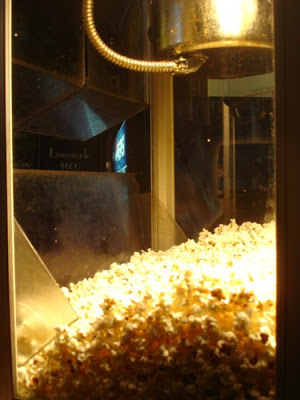
I have an inexplicable obsession with popcorn machines, don't ask my why.

In my first week, I worked a Friday, and saw both the fungus documentary, Know Your Mushrooms and the romantic-thriller Duplicity, starring the dynamic duo of Julia Roberts and Clive Owen. For my second week, it was the animated kid-film Battle for Terra, as well as Watchmen that I saw on my own with some friends, which ended up being quite true to the graphic novel. With week three came Dersu Uzala, the brooding, very slow 1975 Kurasawa film. Week four saw The Silence Before Bach, a retrospective on Bach’s musical life, featuring one of my favorite movie scenes of all time (see video below). With week five came The Garden, an amazing and heart-wrenching documentary on the fate of the largest community garden in the United States. And finally, week six saw both The Soloist, starring Jamie Foxx as an autistic musician-turned-homeless man, and Tokyo! which was definitely one of the strangest films I have ever seen. Three different directors—two French and one Korean, including Michel Gondry of Eternal Sunshine of the Spotless Mind fame—collaborated to present playfully apocalyptic, futuristic tales of modern Tokyo.

My favorite scene from The Silence Before Bach. According to me, it is every cello enthusiast's wet dream.

But great and interesting movies aside, the usher gig wasn’t all rainbows and butterflies. Coupled with the classic loneliness that comes from watching a movie in theaters alone, the job, innocuous as it was, did take a toll on my emotional well-being. Silent hours would pass, especially on weekend nights, with my only confidants being the concession stand operator and the faceless patrons who would smile and thank me as I ripped their tickets in half and put both ends in the deposit (we weren’t allowed to return ticket stubs). There was a certain rhythm to this that I quite enjoyed (I discovered that service jobs do have a particular mindless, carefree quality to them), but more than anything, I wanted some friends to accompany me on the long nights of movie watching past sundown. With the inflated price of movie tickets, though, I oftentimes had to settle for late-night hang-out or study-sessions at a Collegetown café after the film got out instead.

On more than one occasion, though, I staged a protest, collecting a few pristine tickets and pocketing them before they were ripped; later doling them out to friends like bribes for use at a future movie I was ushering. I even managed to crack the color coding system—namely, which color tickets corresponded to which screenings during the week. I considered it my civic duty—as with any job, there had to be the host of necessary benefits that made doing it worthwhile to both you and your friends. It was very reminiscent of the days in New York when Scott took me for the old “Eworks” trick at the Union Square Regal Cinemas, which, admittedly, had gotten us into quite a few run-ins (though all of them price-saving). As a result, some might call this newest indictment “paying forward,” others, “ripping off.” As for me, it was just another day at the office—even if that office was comprised solely of a waist-high ticket deposit and an industrial-strength flashlight.

46 Things Every (Pseudo-)Cornellian Should Do

Not long after arriving at Cornell, my friends and I decided to go on a mission. Deep in the annals of Cornellian lore (I thought it sounded pretty dirty, too), there exists a certain decree—161 tasks that one must accomplish in order to be considered a true Cornellian. In reality, it’s not that old at all (it was published in 2005 in The Cornell Daily Sun), but from the beginning, I knew that the odds were stacked against me. For one thing, I would only be in Ithaca for two months. Second of all, I hardly knew anyone as awestruck with checking items off lists as I am to want to complete this massive undertaking. I’ve never been one for weekly planners, but anyone who has seen my room can testify to a simple white board that holds the key to my daily well-being—events on the agenda, everyday reminders, people to call, songs to download, and future project ideas.

However, I was fortunate to befriend a few people from my class who were up for adventure. Comprised of a rising senior and two rising sophomores, they had just the right combination of jadedness and spunk to humor the whims of this over-curious out-of-towner. We have functioned similarly to how I’ve tried to function with other friend groups my whole life—as the willful planner and organizer, if for no other reason than staving off the dread that inevitably comes with waiting on others to do something. The true folly of youth is that plans get hatched and cracked in nearly the same breath, and there’s nothing worse than being on the receiving end of having been jilted. And so, what started as a way to occupy the long stretches of weekend afternoon in Ithaca quickly turned into a wonderful way to spend time exploring new places and tallying new experiences with friends.

Though quantitatively, I only scratched the surface of the full list, I feel pretty accomplished, considering that about 2/3 of the tasks are really only possible if you are a student during the school year or in Ithaca during a season other than the summer. Not to mention those things that range from the strange (50. Have lunch with President Skorton in the Ivy Room; ask if he's done with that Dijon Burger) to the downright bizarre (74. Throw a flaming pumpkin into the gorge). I wonder, too, how a list like this could come into being at Oberlin. No doubt ride in the Burton elevator, eat a meal at all nine co-ops, and go skinny dipping in the Arb would rank up there. If nothing else, I think that this is something Oberlin students could definitely go to town on—anyone have other ideas? And now, without further ado, here is the full 46!

First, those things which can be adapted to my time at Oberlin (18):
6. Illegally slide down [Mount Oberlin] on a tray from [Stevenson].
9. Take Psych [100].
13. Climb the rock wall in [Philips Gym].
17. Go to the [Peters Observatory] and gaze at [Saturn].
18. Have a snowball fight in May.
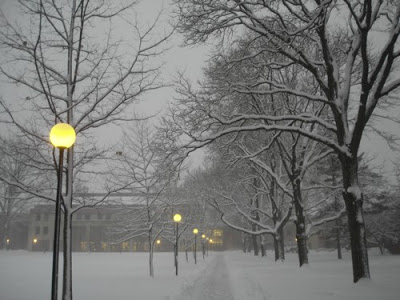
26. Live through an [Oberlin] blizzard and tell your friends how you survived frostbite.

Oh, how I will miss Oberlin winters.

32. Go to a Shabbat dinner at [Kosher Hillel].
37. Take a class you think is impossible just for fun.

For the record, it was Modern Dance during my senior year, which ended up being a great class.

41. Shop at the Friends of the Library book sale.
48. Have dinner at a professor's house.
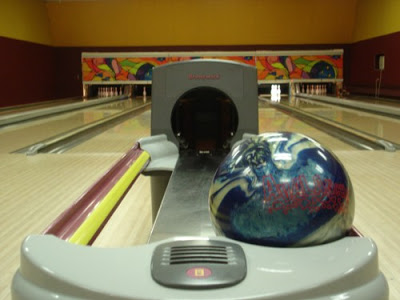
84. Go bowling at [College Lanes].

My very own bowling ball, "The Avalanche," and the Oberlin College Lanes.

94. Go to an a cappella concert.
115. Get guilt-tripped into giving blood.

And subsequently end up giving blood every eight weeks for the next four years.

117. Drink with your R.A.

Does it count if you were the R.A.?

119. Sing drunk on the [RideLine] bus.
137. See how many people you can cram into your dorm room.
152. Study abroad.

My semester abroad in Japan was one of the highlights of my college experience.

160. Have the courage to tell a professor what you really think of his or her class.

And now, for my two months at Cornell (28):
10. Test out Olin Library's musically calibrated steps by throwing stones on them.
11. Go sake bombing in Collegetown (for the over-21 crowd only!).

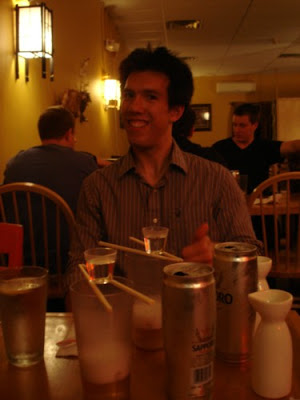
I took a trip to Miyake with my roommate and his friend Sam. For my first time, it was shockingly no-frills, but definitely fun. Clearly, this picture was taken before we got started...

12. Order ice cream at the Dairy Bar.
14. Listen to a full chimes concert from the clock tower and guess the songs played.
114. Request a song to be played on the clock tower.
161. Climb all 161 steps to the top of McGraw Tower.

Getting the chance to go to a chimes concert was truly an awesome experience. It helped that even during the summer, there were a handful of concerts put on each week, all completely open to the public. The Chimes have a rich history at Cornell, and the ten so-called "chimesmasters" certainly seem to have a lot of clout on campus—responsible for performing three 15-minute concerts daily during the school year. The instrument looked quite physically demanding, which made it all the more fascinating to see the chimesmaster in action.
A view of McGraw Tower lit-up at night.
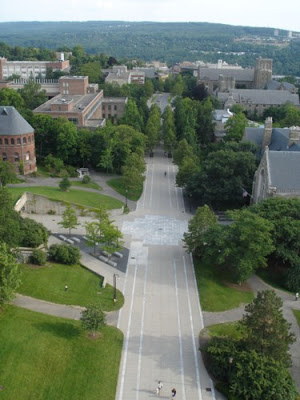
One of the other big perks of going to a chimes concert is the stunning panorama from the top of McGraw Tower. This is a view of Ho Plaza.

20. Play frisbee on the Arts Quad.
34. Enjoy corn nuggets at the Nines.
45. Attend an opening at the Johnson Museum of Art.

Though not quite as well-known as Oberlin's Allen, its Asian collection is especially impressive. Ironically, it is also closed Mondays. The opening we attended was for an exhibit called The Art of China's Cultural Revolution (photo courtesy of Jannine Chan).

46. Smuggle food from the dining hall and run for your life as they try to get back your stolen cookies.
51. Play a game of tag in the Kroch Library stacks.

Surprisingly, one of the most fun outings I have had in a long time. It felt strangely refreshing to (silently) run for my life like a nine-year-old again.

60. Sit in Libe Cafe when you have no work to do and watch the worried studiers down gallons of coffee.
64. Go to a fraternity party as a senior; convince yourself you were never one of them.

With no Greek life at Oberlin, I had to at least see what all the fuss was about, right?

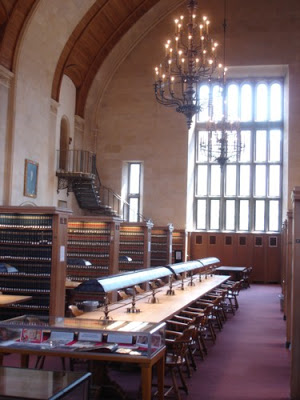
65. Pretend you're Harry Potter and study in the Law School library (looks like Hogwarts).

I don't really see it, but, to be fair, I also know next to nothing about Harry Potter.

66. See the brain collection in Uris Hall.
69. Take part in a psychology experiment.
80. Go to karaoke night at Rulloff's on Mondays.

It shouldn't be surprising that we crooned our hearts out to Mariah Carey's "Heartbreaker." Bonus points to the first person to correctly identify the song on the teleprompter.

86. Take an unplanned nap in the library.
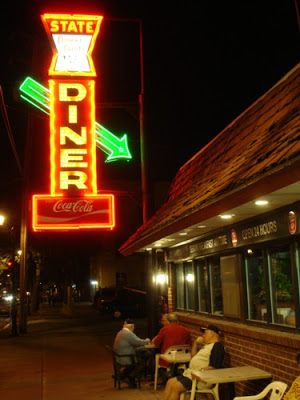
89. Eat breakfast at 2 a.m. at the State Diner.

It wasn't quite 2 a.m. when we went, but, as with most diners, it may as well have been.

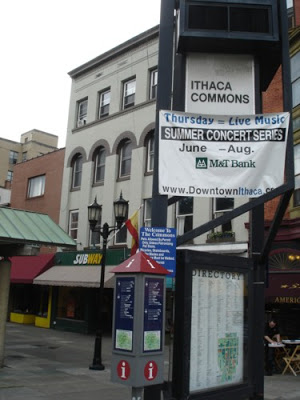
93. Walk to the Commons and back.

The Commons is a trendy little strip in Downtown Ithaca with lots of shops and restaurants—which unfortunately, I didn't frequent as much as I should have in the last two months. The walk down was surprisingly brisk, even coming from the complete opposite side of campus. But it was hiking back up the massive incline known as East Buffalo Street that really did me in.

96. Eat pizza at the Nines.

Not quite as good as Chicago Deep Dish, but surprisingly tasty, especially for pizza outside of the city (photo courtesy of Jannine Chan).

98. Drink bubble tea.
101. See the library's Rare Book Collection.
108. Eat brunch on North Campus.
121. See how long you can go without doing laundry.
141. Ring the giant bell at the Plantations.
156. Eat at each dining hall at least once.

At least all three that were open during the summer.

And finally,
31. Enjoy Ithaca's two months of warm weather by spending a summer here.

A view of Ithaca from the top floor of the Johnson Museum.

Be Like Mike (Or Mishima for That Matter)

There’s nothing quite like meeting the day with a breath of fresh air. Which is exactly how I leave my apartment every morning. The daily one-and-a-half-mile walk to class that I once met with trepidation now feels almost luxurious. Never before have I had such an opportunity to process my thoughts and get myself mentally prepared to start my day. I am thankful that despite Ithaca’s famously erratic weather, each day starts out almost exactly the same way—sunny, very mildly humid, just the slightest bit chilly, and damp from the morning dew. It reminds me, almost uncannily, of my dad’s house in the summer—birds chirping, breeze rustling tree branches overhead, overgrown brush, an eternal sun—not too surprising, given that he only lives about three hours south of here.

That feeling I get in the mornings is rivaled only by the rush I have after a workout. I don’t consider myself to have a very addictive personality, but endorphins certainly rank among the relatively few things that I need in life in order to stay sane. It would hardly be a stretch to say that without exercise, I would probably fall apart emotionally. Not only is it great for combating stress, but it does a number for personal problems too. There’s something about making my body work hard that seems to preclude any room for negative thoughts—in essence, if my body is happy, then my mind is at peace. No matter how badly I’m feeling, I can absolutely count on the fact that after lacing up my sneakers and jogging to the gym, I’ll inevitably feel like myself again.

It’s an outlook not too dissimilar from that of a man I can only tangentially claim to know a modest bit about: the 20th-century Japanese author, Yukio Mishima. Particularly astute and long-time readers of my travel chronicles will no doubt recall that I made mention to Mishima in one of my many missives from Japan—likening my fastidious penchant for working out with the writer’s own. I learned about his life most notably from an essay he published in 1968 called Sun and Steel and the 1985 BBC documentary, The Strange Case of Yukio Mishima, both of which I was exposed to in my Modern Japanese Literature class in Japan. Please excuse me as I quote from Japan 23, my two-month reflection entry (notice how little my writing style has changed in almost two years):
It seems like the two things that kept Mishima going in the later half of his life were the exorbitant amount of writing that he did and the lengths to which he worked out. Needless to say, I have not gone to such extremes in either respect (you should see pictures of this guy—I never thought bookish author-types could get so buff!), but it is just funny to me that two of the things I have derived a great deal of joy from recently are the very two that this guy made a life out of doing. With that said though, there are some key differences between us, including the fact that he died by committing ritual suicide with his gay lover at an anti-extremist government protest (of which he was an extreme right-wing conservative), all of which are not currently on my foreseeable agenda, but it’s still kind of interesting to think about all of this and its relation to me.
According to Wikipedia, Mishima took up weight training in 1955 and his workout regimen of three sessions per week was not disturbed for the last 15 years of his life—certainly a pretty high achievement. Perplexed by what seemed like an odd fascination for a highly-celebrated author, I went on to write my final research paper in that class on Mishima’s interpretation of light—and how it compared with that of another famous Japanese author, Jun’ichiro Tanizaki. I discovered that Mishima ultimately credited light as an enlightening, restorative, and masculine presence that gave him the tools necessary to obtain a certain amount of strength (steel) in his life. He wrote in his essay Sun and Steel that, “The sun was enticing, almost dragging, my thoughts away from their night of visceral sensations, away to the swelling of muscles encased in sunlit skin. And it was commanding me to construct a new and sturdy dwelling in which my mind, as it rose little by little to the surface, could live in security.”

What’s strange is that despite Mishima’s accolades for natural light, Osaka, quite like Ithaca, doesn’t really get all that sunny. Long stretches of day are consumed with ominous cloud cover and smoky fog, and by the time afternoon sets in, I, eternally umbrella-less, am often poised to get wet. In fact, weather is one of the main reasons why I find myself comparing the two places in the first place (as well as my subsequent experiences therein). For one thing, I’m devoting myself to learning a foreign language for several hours a day. Secondly, my schedule is relatively high school-esque in that I have classes that start early in the morning and run all throughout the afternoon, with lots of time to myself at night. And thirdly, I find myself wanting to exercise and write all the time (sometimes to the abstention of other things). I like to romanticize this notion at times—that here, as in Japan, I can walk out of the gym on a rush of endorphins, sidle into the adjacent cafeteria completely absorbed in my own thoughts, and help myself to a pleasantly stoic meal, all before rejoining the real world on my walk home.

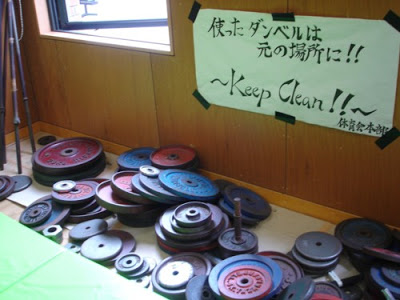
The gym at Kansai Gaidai University in Japan. Unless it's changed radically, Eric and Mariko, this is what you can look forward to next spring!

I believe that despite some of the negative stereotypes associated with working out (or at least weight lifting), like Mishima, my ultimate goal is to provide a physical receptacle for my thoughts that can rival their potential merit. Like living in a room that is perpetually unkempt, I find myself unable to think or concentrate well when I know that my body isn’t happy. It is only when my physical well-being is temporarily accounted for that I can then move on to other matters. Of course, like all things, there are exceptions—midterms and finals being a few of them—but it’s an adage that I have lived with ever since 10th-grade high school track. What started as a friendly challenge between friends quickly put me on a life-changing path with regard to my fitness goals.

I learned that although I am not cut out for competitive running, ever since then, I have taken stock of my physical condition and made it my business to maintain the good health I am fortunate to have. I have a relatively old-fashioned view when it comes to strength. Assuming for a minute that it were even possible, far from aspiring to become one of those ripped athletes or body builders (who, in reality, kind of creep me out), I want to build strength for the practical purpose of survival skills—being able to lift my own body weight, carry a heavy load, or hoist a person up from a precarious position—not because I think that I will really ever be in that predicament, but so that in some ways, I can feel more self-sufficient in whatever tasks I will inevitably have to encounter on my own.

What’s great is that unlike at Oberlin, I finally have the free time to really get a decent workout everyday here—and don’t have to lie when I say that I go to the gym five times a week. Monday, Wednesday, and Saturday are for weight lifting and Tuesday and Thursday are reserved for cardio; a routine that I have consistently tried to stick to for the past four years. I can credit most everything I know about weight lifting to Men’s Health and an Australian named Robert who I met when I was studying abroad in Japan (and who I later tried desperately to adopt an Australian accent from). Sprinkle in some advice from my friend and gym advisor Seyeon, and that pretty much rounds it out. As far as facilities go, Cornell’s fitness centers are more than sufficient. Although I really only go to one of them because it is so much closer than the others, I have visited all three that are open during the summer. Each has its own specialty—one has a rock climbing wall, another has a swimming pool and a bowling alley, and the third has squash and racquetball courts. As mentioned in my first post, they do charge a flat-rate membership fee, but it’s far cheaper than it would have been to go back to my old gym in Manhattan anyway.

I’m pretty happy with my routine overall. As the title of this post would suggest, I’ve been playing a lot of basketball. The courts are usually quite crowded, but everyone is really respectful and good about rotating out teams, making it an ideal set-up for pick-up games. I also recently started doing a 6-week push-up program, the goal of which is to eventually enable you to do 100 consecutive push-ups. It’s been super-grueling and I’ve been waking up to sore arms every morning, but I’m on Week 5 now, and it feels so cool to take the weekly progress test and see how many more push-ups I am able to do than in the previous week. And thanks to my roommate, I’ve also gotten quite fond of squash. As far as workouts go, it doesn’t get much better—I am absolutely covered in sweat from head to toe by the time I get out. I had only played squash once before coming here, but already I am hooked—and trying to best my roommate using the pointers that he himself taught me on the side. On the drive back home, we make it a habit to blast Beyoncé’s “Halo” at an embarrassingly high volume (though this is nothing compared to the entire evening we spent eating ice cream and watching the better part of Season 2 of “Gossip Girl”—true story).

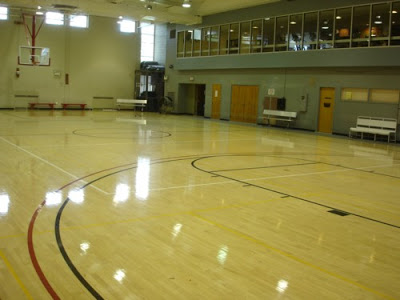
The basketball courts and weight room (located upstairs through the glass windows) at Cornell.

Of course, we all know that the real reason I work out is so that I can eat a lot of food afterwards, not to mention impress the swarms of high school girls that I’m forced to dine with on a daily basis. I must say, though, that if nothing else, being in college has made me so appreciative of the fact that I am no longer in high school. However, I do admit that eavesdropping on their conversations makes for some fascinating hypotheses into the inner workings of the teenage mind. As far as nutrition goes, since I’ve been able to eat so much meat lately in the dining hall, I’ve been off the white stuff (that’s whey protein)—though it is largely because I wasn’t able to lug the absurdly large container up to Ithaca in my suitcase. But generally, I feel better about the situation, especially because I was always worried about my protein intake when I was eating in a co-op. Despite it being cafeteria food, I’m doing my best to eat a balanced diet—lots of vegetables and meat, light on the starch, and fruit for dessert.

I daresay that I feel healthier and in better shape than I have ever felt before. I feel stronger, have more energy, and for a small nominal fee, I also do infomercials. If living in Japan taught me anything, though, it’s that I really have to watch myself in China. I’ve been largely fine in the states, but apparently being around a lot of cheap, delicious food that I don’t have the willpower to stop myself from consuming can become problematic. I gained about 7 kilos after four months in Japan (about 15 pounds), and that was by a conservative estimate. Everyone’s heard of the “Freshman Fifteen,” but really, we’re forgetting the true scourge at hand here—the “Chinese Forty!”

Free: It's What's for Dinner

Well, it finally happened. But when you think about it, it was inevitable really. Ever since I got to Ithaca in June and started cooking for myself (not counting, of course, the three years I spent dining in Third World Co-op), I have found it strangely comforting to listen to National Public Radio, a pastime I had previously thought reserved for liberal-news-hungry forty-somethings, like my father. It comes as just the latest in a long line of interests I have adopted from my dad over the years (poetry and photography included). Growing up, it was as simple as fact—when it came time to cook dinner, my dad would crank on NPR, and my sister and I knew that we would be in for an hour-and-a-half of boring (that’s BOR-ing in kid speak) talk radio, stifled only by the sounds of clamoring dishes in the kitchen.

It took some time, but eventually I got used to it—and daresay even came to enjoy it. First, it was Garrison Keillor’s “News from Lake Wobegon” that struck a chord with me, nothing if not for Keillor’s eminently soothing Midwestern drawl and the rousing “Guy Noir, Private Eye” segment that even as a youngster I found incredibly entertaining. In my teens, my focus shifted to This American Life, thanks in large part to Mr. Kawano, my high school Creative Writing teacher, who played segments in class and put the content of obscure archived shows on our final exam. He long contested that there were only two things one needed to do to be a well-informed citizen—the first was to listen to This American Life, and the second was to read The New Yorker. On long car rides up to my dad’s house in Rosendale, NY from the city, I sat buckled in the backseat, keeping one ear locked on the radio program and the other on my sister, whose weekly gossip spread whisper-soft across the seats.

Nowadays, it hardly matters the NPR program—I find almost any show worth listening to, especially because a lack of TV reception up here prevents ready access to the day’s news. I often cannot work without at least some kind of white noise, even if that simply means putting on a mindless TV show to have playing in the background. I first flipped on NPR’s live webcast hoping that it would serve a similar purpose, but I found it impossible to concentrate on work because I became so engrossed in the program! Finally, I thought I’d give cooking a shot with my computer-turned-radio humming in the background, and it worked like a charm. I love listening to the live stuff (mostly All Things Considered) because it is reassuring to be on the same frequency as other human beings, but with the advent of podcasts, I am constantly checking out other content as well. Above all, I have come to really appreciate Wait Wait… Don’t Tell Me!—a weekly news quiz show that is as informative as it is hilarious.

It’s so nice to be able to learn something in time that otherwise might go to waste (I assume the same might be said about driving, of which my four-year hiatus prevents me from forming a solid judgment), which is why I imagine my dad started the ritual to begin with. All I can say is that it is one that I will certainly continue to explore here in Ithaca, and will definitely take with me on my culinary endeavors abroad in China.

Cooking itself has been great, even in spite of the somewhat redundant selection of ingredients. Coming from a co-op background, I have been slightly reluctant to change my old ways, which means that weekly grocery trips often net the same basic staples—mushrooms, peppers, broccoli, bok choy (when it’s available), tomatoes, carrots, onions, potatoes, eggs, yogurt, apples, peanut butter, and of course, white rice. But with a more flexible budget, I have been able to substitute out the tofu that I would largely eat en masse for some meat—largely just chicken and ground beef, with the noted exception of hot dogs as elucidated in my previous post. I’m not too big into the “instant” variety of food, but I debated buying some pre-packaged Thai meals just to have on hand, only to wonder whether I would be offending my roommate if I did. A part of me wants to break the mold and start doing some culinary experimentation, but thus far, I have been a little too nervous over the outcome to try.


My cooking abilities are far from refined—owing partly to the fact that I often stray from using spices and seasoning in favor of the food’s natural flavors—but I am perfectly content with cooking for myself. The problem lies in entertaining others, a difficulty that I hope to overcome in the near future. I have, though, cooked for my roommate on a couple of occasions, and thanks to his selection of sauces and spices, I was able to conjure up something decently appetizing. It’s handy to be able to use the various pots and pans he has on hand, not to mention all of his bowls and silverware, because god knows I don’t own any of that myself. Of course, it would help if I used a cookbook every now and then—improvisation, though wonderful, might not be best employed when it’s the only tool in a relatively new cook’s arsenal. I haven’t used one in ages, but I imagine if I actually had to follow a recipe, I would be less scared to try out other types of food and styles of cooking. If anyone knows any good ones, I would be happy to take suggestions.

Pictured throughout this post are some of the various dishes I have made for myself. It was my friend Alisa (much more talented than I, mind you) who first got me hooked on food photography, a hobby I have not put down since, much to my father’s feigned dismay. But it may be catching on with more people that I would have expected. My friend Jannine here at Cornell was described by a mutual friend as “the only other person besides [me] who likes to take pictures of her food.” Even my friend Eric from high school and his brother started a blog dedicated solely to postings of food photos. It’s not even that weird anymore when my roommate walks in to find me hunched over the kitchen table balanced precariously above a plate of fast-cooling chicken. I can only imagine what an amazing job it would be to be a food critic and photojournalist all at once.


In terms of shopping for food, the selection has been great. I’m glad that I don’t have to frequent the local Wal-Mart and can instead hand over my money to other large, thriving, and probably equally corrupt conglomerates located conveniently nearby. We have a Topps and a Wegman’s within easy driving distance and I’m fortunate to be able to call on my roommate if I’m ever in need of supplies. There is also a small Asian market in town—the place where I buy all my Chinese broccoli, tofu, Korean BBQ sauce, and taro tapioca popsicles for dessert. Though I had scarcely ever even heard the name before coming here, Wegman’s has attained a certain cult status in town, as various friends and acquaintances have talked up the great amusement of spending an afternoon (or a Friday night) perusing the seemingly infinite number of aisles, leaving the store with much more than you expected to buy in the first place. And I don’t blame them—the store is set up expertly in terms of food displays and marketing. I heard that a trick supermarkets sometimes use is putting the fruits display right in the front where the customers come in. It would seem pointless as fruits don’t generally make for a huge draw, but when busy customers stop into a grocery store in a hurry to get out, choosing the right fruits takes time, thus slowing down the rest of their visit too.

The trick is to come in with a list—thereby weeding out those aisles you know you can bypass. Of course I have yet to follow my own advice, but surprisingly, I have discovered an unusual source of will power, at least when it comes to buying food. I have seen far too much of it go to waste in my lifetime to know the value of being able to eat something before it spoils, thus saving money and conserving the already scarce resources on this planet. It helps too that I am only buying for myself, and so I know the extent to which I can and cannot eat a given amount of food in a week’s time. Thus far, I haven’t had to throw away a single thing, and I hope that it stays that way.

Which is good news for Shansi, as they are footing my grocery bills for my time at Cornell. In these tough economic times, I am trying my best to stay within my budget— regrettably evading the assorted selection of fine wines, lavish desserts, and fresh-caught Alaskan salmon. Hell, it’s even a splurge when I decide to buy the 90% lean ground chuck over the 80/20. I guess it says something about me that I am even frugal with spending other people’s money. My own economic situation, though, has also been quite interesting. I seem to find few qualms about paying close to $100 to visit NYC for a weekend, but I fret endlessly over whether to buy a green pepper or a red pepper at the store for just a dollar more (of course, I went with the green pepper despite the bitterer taste). Seeing friends in the city has been undoubtedly worth it, and I will definitely have to dedicate a post to that in the near future.


But when I’m not cooking on my own, I eat at Cornell’s dining halls. Their “award winning” food has lived up to its name in many respects. I am actually quite excited to go there every once in a while when I don’t feel like cooking at home. They offer a pretty decent selection to choose from—“chef’s table” specialties, soups, salad, grill, pizza, and a dessert bar. They locally produce some of their food, including select fruits and vegetables, at a student-run farm not unlike George Jones Farm at Oberlin. Cornell also has its own dairy outfitter on campus, which makes everything from milk to lemonade to whipped butter. I say “whipped butter” and not ice cream because Cornell's ice cream is so high in fat that the FDA refuses to certify it unless it goes under that much less flattering pseudonym. As a result, the ice cream is not FDA-approved, but it sure is delicious nonetheless. I wouldn’t be surprised if they also raised cattle on the side—their burgers are quite tasty, if a little overcooked, but you can never be too careful with salmonella these days. They also run their own orchard located on the so-called “Plantations,” which I have yet to visit.

The only downside to the meal plan is the cost. With thirty meals and 200 Big Red Bucks (essentially Flex Points) for $500, it works out to about $10 per meal at the dining halls. Ten bucks is pretty expensive, considering it usually costs me less than $50 to buy groceries for all my meals for a week—and I eat a ton. However, as you might expect, I have devised a way to maximize every meal that I take at the dining hall. With a cleverly discreet backpack, I manage to walk out with no less than the following items after nearly every meal: bananas, bagels, hard-boiled eggs, plums, apples, and a plastic Chinese takeout container’s worth of the day’s specials. It all goes toward my six-meal-a-day diet—having many smaller meals spaced out throughout the day rather than three big ones. I eat a PB&J bagel every morning for breakfast, a banana in between my morning classes, the pre-made take-out container for lunch, and the rest of the food at various points during the late afternoon and evening. Factor all of that food into the cost of a single meal, and the price drops to about $3 or $4 per meal—certainly a much more reasonable cost. Best of all—it’s totally sustainable! I reuse the take-out container, Ziploc bags, and even the plastic silverware I take with me to eat.

Today's leftovers are tomorrow's lunch!

And there are other avenues at Cornell for the discerning freegan. Much like DeCafe, I learned that when the Olin Library Café closes at 5pm every weekday, all of the bagels and croissants are left up for grabs. In addition, I was shocked to learn that Cornell also boasts a co-op housing and dining system. Though much less extensive than Oberlin’s, it has nonetheless found a niche on campus to rival that of the burgeoning Greek powerhouse. I recently reconnected after ten years with my 5th-grade crush (she just graduated from Cornell), who is living in one of the co-ops called 660 Stewart. Walking in to meet up with her was like being plucked back down in Oberlin—communal bulletin board in the living room, Hobarts and giant woks in the kitchen, and labeled leftovers piled up in the industrial fridges. Of course, Ithaca’s certainly got its share of restaurants too, and it would be foolish not to sample some of the many cuisines in the area. With all the money I'm saving, you would think Shansi might even include it in the budget!

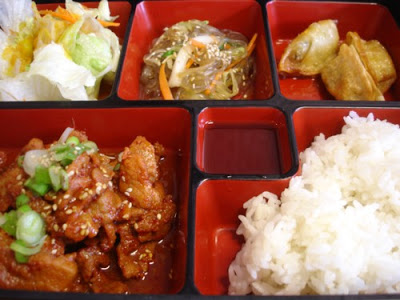
A Korean box lunch at "Four Seasons."