• About
  • Publications
  • News
  • Events
  • Book
  • Contact
  • Home
  • Blog
  • What Never Leaves
  • Menu

Daniel Tam-Claiborne

Travel Breeds Content
  • About
  • Publications
  • News
  • Events
  • Book
  • Contact
  • Home
  • Blog
  • What Never Leaves
Subscribe
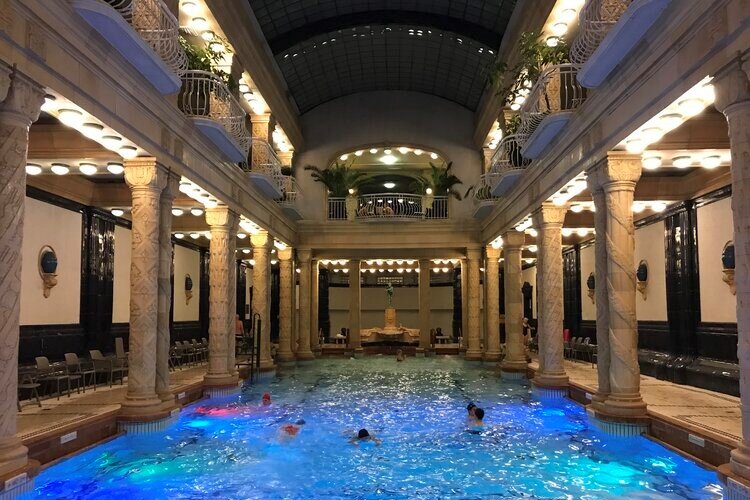
Gellért Baths, Budapest.

Gellért Baths, Budapest.

Day 18: Gellért Baths

January 22, 2021

It felt like a return to Jewish life back home. For lunch, we shared a hummus platter, matzoh ball soup, chicken paprikash, and a fascinating Israeli bean stew called cholent, typically eaten on the Sabbath. We followed it up with a trip to the Dohány Street Synagogue, the largest synagogue in Europe, impeccably decorated with elements of medieval Spanish and Islamic art. The inside was a full-blown identity crisis: brass chandeliers, a choral organ that towered under two Moorish onion domes, and a rose stained-glass window. Bordering the Budapest Ghetto, the Synagogue, much like the Old New Synagogue in Prague, comprised the ill-fated holy trinity of European Jewish landmarks: graveyard, memorial, and museum.

I found myself thinking—of all things—about my high school classmates, and how many of them had roots that traced back to Budapest. After all, our tour guide—a straight-faced, older Jewish man in the tradition of Frank Costanza—reported that following the near-destruction of the synagogue during WWII, funding for the renovation was taken up predominantly by influential New York Jews. Certainly, any number of my former classmates could have taken pilgrimages to the synagogue over the years; I could have sworn I’d even seen Lauren Levine, standing by the weeping willow sculpture, whose leaves bear inscriptions with names and tattoo numbers of the dead.

It wasn’t the only false alarm of the day. Courtney and I tried to track down a portion of the original Ghetto Wall—eventually moonlighting as part of a Spanish tour group—only to discover that the courtyard of a high-rise apartment complex we entered was merely where the Wall stood up until its demolition a few years’ prior. The area around the Ghetto had developed as you might expect: fancy bars, high-end art galleries, bros in hot pink tank-tops. It would surely have been unrecognizable to anyone with even the faintest connection to its past.

But what else is new? So often it is only our memories that remain after the past is paved over. And so, we leaned in. I bought a strawberry donut Frappuccino from the nearby Starbucks and we ambled awe-struck—like true tourists—over to the New York Palace Hotel, a longtime center for Hungarian literature and poetry. The gaudy ornamentation, complete with sixteen lamp-bearing stone fauns, had itself, I learned, also been rebuilt after WWII—and also by New York Jews.

In the evening, we visited Gellért Baths, the most famous of the many bath complexes in Budapest. Before I arrived, I pictured the public pool in Red Hook, where on weekends in the summer me and my sister used to visit with my dad. The pool was always mobbed: children with their parents, teenagers trying to impress their dates, serious athletes doing laps. It was built just before WWII and owned—are we sensing a theme here?—by the Goldman family in New York.

I’d just stepped into the first pool at Gellért when I wondered about the Jewish fascination with water. Bathing is referenced in the Bible not only for cleanliness but also for ritual. The Talmud declares it forbidden for a scholar to reside in a city without a public bath. The mikveh, a bath used for the purpose of ritual immersion, is central to the Orthodox community.  The Gellert Baths remained open throughout WWII and survived almost wholly intact. The thermal baths contain water from nearby mineral hot springs, in addition to saunas, plunge pools, and—yes—even a swimming pool, though unlike the one in Red Hook, enclosed by an Art-Nouveau style glass roof. Whether it’s the healing properties of the water or a miracle of faith that’s kept the Baths running, I can’t say. But when I dunked my head underwater and emerged revived, I was thankful for some experiences that manage to stay the same.

Tags: Euromoon
Prev / Next
No results found

Latest Posts

Featured
Climate-Artist-VOD-Artwork.jpg
November 25, 2024
Climate Artists
November 25, 2024

Climate Artists is a five-part documentary series that explores how the climate crisis informs and inspires artistic expression. Through the lens of diverse artistic mediums, the series illuminates what can happen when art intersects with environmental advocacy, and how artists can use their work to engage awareness and foster compassion for our planet.

Climate Artists is a co-production of ALL ARTS and The Serica Initiative.

Watch at PBS.

Read more →
November 25, 2024
30-band-steps.jpg
November 11, 2024
Pink Martini's America
November 11, 2024

Thomas Lauderdale never intended to become a professional musician.

This may be surprising, considering that Lauderdale is best-known as the charismatic band leader of Portland’s self-described “little orchestra,” Pink Martini. With twelve albums featuring songs in twenty-five languages, Pink Martini’s music deftly fuses classical, jazz, and old-fashioned pop to create an eclectic and timeless aesthetic that is entirely their own. Now entering its 30th year, Pink Martini has sold millions of albums, and tours their world-renowned repertoire 150 days out of the year, across the globe. “If the United Nations had a house band in 1962,” Lauderdale has said, “hopefully we’d be that band.”

Read more at All Classical Radio.

Read more →
November 11, 2024
Portland-branding-photographer-kenji-bunch-8.jpg
August 6, 2024
Keep the Joy Intact
August 6, 2024

Long before Kenji Bunch established himself as one of America’s most influential and prolific composers, he came to classical music in a way familiar to many young Asian Americans. “For a long time, I’ve tried to come up with any other reason, something somehow more intelligent,” he said. “But what I’ve realized is that I saw classical music as my calling largely because it made my parents happy.”

Read more at All Classical Radio.

Read more →
August 6, 2024
Juju-Chang-Qian-Julie-Wang-Jose-Antonio-Vargas-Mira-Jacob.jpg
June 12, 2024
Voices Rising: What's Next for Asian Americans in the Arts?
June 12, 2024

Hosted by Juju Chang, the Emmy Award-winning anchor of ABC News Nightline, Voices Rising: What’s Next for Asian Americans in the Arts? delves into the pressing issues and opportunities Asian American artists face today.

Featuring in-depth conversations with distinguished panelists; including BD Wong, David Henry Hwang, Rosalind Chao, Jose Antonio Vargas, Qian Julie Wang, and Mira Jacob; and interspersed with performances by Naomi Funaki, Mikiya Ito, and Pooja Reddy; this special comes at a crucial time when anti-Asian hate is on the rise, yet there is also a remarkable celebration of Asian American talent at the national level. 

Voices Rising: What’s Next for Asian Americans in the Arts? is a co-production of ALL ARTS, Exploring Hate, and The Serica Initiative.

Watch at ALL ARTS.

Read more →
June 12, 2024
IMG_2032.jpg
November 22, 2023
Friend in Me
November 22, 2023

It was the kind of movie theater that didn’t have a marquee. Grand Avenue Cinemas was located on a dismal stretch of Long Island, sandwiched unceremoniously between a liquor store and a Dollar Tree. The four of us had driven there from Jones Beach, the sun waning in the sky, on the kind of perfect summer day that seemed to signal that the summer was coming to an end.

Read more →
November 22, 2023
Archive
  • Bay Area
  • Beijing
  • Euromoon
  • Ithaca
  • Japan
  • Kenya
  • New Haven
  • New York
  • Oberlin
  • Seattle
  • Taigu
  • Taiwan