Day 2: It's a Mad, Mad World

I've been feeling an awful lot like Donald Draper lately. Maybe all of this incessant Mad Men watching has gone to my head, or maybe I'm just inventing a more exciting life for myself to escape the Taigu grind, but either way, the drama is quickly becoming the biggest thing since Desperate Housewives. It's been interesting watching the men from the show in action—irresistible and yet simultaneously nonchalant in all of their sexual dealings, wielding incredible power due to their status, and, most of all, completely unaffected by how their actions complicate and oftentimes hurt the lives of the people closest to them. I can't say that I've exactly taken up these character traits myself, but they've certainly been wearing away at my mental defenses.

For one thing, I've been reveling in being the target of a woman’s desire. In China, as in most of East Asia, simply being foreign is enough. No longer is there the explicit need to be savvy, smart, good-looking, or even well-off (that one they assume about you from the get-go). If you are vaguely white and speak English, you are the proverbial golden ticket. Not surprisingly, though, this fills me with equal parts dread and disgust, in the same way that “yellow fever” makes me want to take out my trusty Oberlin CAS lens and analyze it to pieces. It's not to say that these kind of relationships can't be valid in their own way, and there is certainly the argument that a few otakus in Japan ruined it for foreigners everywhere, but any relationship based solely around the projecting of one's own stereotypes and preconceptions on another culture seems to me inherently flawed.

What would Donald Draper say about all of this?  Frankly, probably not a whole lot (photo courtesy of TV Fanatic).

As far as I can tell, relationships are tricky enough in Taigu as it is. Students barely have enough privacy to use the bathroom, let alone try to have an intimate, physical relationship with another person. Most of the time, those sexual urges manifest themselves in chilly late-night make-out sessions in the so-called “Lover's Forest,” where shining a light to navigate the darkness sometimes means silently agreeing to a manage-a-trios. If we were all to believe the stereotypes about China, young people get together for the sole purpose of constituting a marriage, family plays a central role when choosing a potential mate, love is weighed as equally as money, and divorce might as well be social suicide. But like all things, the reality of the situation is much more nuanced. A lot of students I've talked to are just as apprehensive about marriage as I am, believe that it is preferable to live together with your partner before taking your nuptials, and—get this—have no interest in marrying a foreigner.

Nevertheless, I feel in Taigu that because of my “exoticism” as a halfie—making me just familiar and just foreign enough—I get a lot of unsolicited attention—attention that I am not ashamed to have doted on me. It all goes to your head sometimes. But for me, that's as far as it gets. As tiring as it is getting called “handsome” on a daily basis by at least a couple of young, attractive females, I know that a year from now when I'm basking in re-entry culture shock, that salutation will be sorely missed. So for now, I am giving them my best Don Draper—the smooth, silent-type who can manage a board room in his sleep, incite pangs of envy everywhere he walks, and drive the women wild with his smile. Taigu, eat your heart out.

Day 1: Cruel and Unusually Tacky Punishment

Being woken up at 7:30 on a Saturday morning is one thing.  But being woken up by ear-splitting muzak driven from a musical fountain about thirty yards from your window at 7:30 on a Saturday morning is something else entirely.

When the Office spoke excitedly about the musical fountain's new addition to SAU's campus last fall, the mood was unanimously optimistic.  It was a big investment on the part of the school—a fountain about the size and scope of that opposite Radio City Music Hall in New York's Midtown, featuring speakers the height of vending machines and dozens of jets of colored water that set off like fireworks to the tune of each song.  It's not to say that the school couldn't have used that money on other, more-pressing concerns, like mitigating 200-person lectures to more manageable class sizes, or renovating scores of over-capacity and under-inspected student dormitories on campus.  But we all agreed that it had enormous potential and would go a long way in helping to beautify the area of campus between the old-style foreigner living quarters and the more-modern English majors building.

The musical fountain on campus, its noon-time clear-spray jets in full force.

That was until we heard it.  Freshmen orientation at SAU, much like that at Oberlin, involves brightly-colored banners, local businesses tabling for new cell phone plans and bank accounts (with unbelievable incentives!), and a procession of bright-eyed first-years toting over-sized luggage to their new dormitories.  What Oberlin doesn't have is a soundtrack to narrate such surroundings.  Beginning at 7:30 and continuing at a stretch with only minimal breaks every three or four hours until sundown, the musical fountain churned out an exalting playlist of no more than eight or nine MIDI-inspired remixes of songs on loop that, truth be told, don't even sound that good as originals.  It was like this awful Catch-22—leaving the house only intensified the volume of the music, but being inside wasn't enough to drown it out to any suitable degree.  It may have been the first time in my life when locking myself indoors no longer passed as a feasible escape plan. 
Hearing each song close to 40 times made memorizing the entire line-up quite effortless (especially when compared with actually listening through them):

Kenny G - “Forever in Love”
Stevie Wonder - “I Just Called to Say I Love You”
Selena - “I Could Fall in Love”
Celine Dion - “My Heart Will Go On (Love Theme from “Titanic”)”
Ray Orbison - “Pretty Woman”
Henry Mancini - “Moon River”
Wham! -  “Careless Whisper”
Kenny G - “Going Home”
Like the worst day at the dentist's office or the longest possible elevator ride, so too did orientation weekend come to pass here at SAU.  If they had only decided to vary the set-list slightly—even with songs that were equally stomach-churning—it would have truly been a godsend.  I felt like Alex in a newly-imagined A Clockwork Orange—ears fixed to my reverberating windows, blood boiling from the relentless saccharine refrains just beyond my control.  More than once I contemplated sneaking into the tech booth with a wire cutter and shorting the power on that brazenly-expensive piece of equipment.  It just seemed to confirm what I already knew about China—that the concept of privacy is less an afterthought than it is a fantasy and individuals, whether they like it or not, will eventually succumb to the will of authority.  At the end of the day, there was a part of me that absolutely despised it all.  And a part that found me transfixed and wanting more.

Shorts, Shouts & Murmurs: The Annals of Taigu

Like any small town, Taigu is not without its share of stories. And also like any small town, the stories are what make Taigu special. They come from any number of places—the old couple at the granary where we buy rice, the punk kids on motorbikes who approach us when we walk to dinner, the kind woman we buy milk tea from in North Yard, students and friends of students who invite us out on the weekends, and even our own bosses in the Foreign Affairs Office. The people color our experiences and shape our daily lives here, and like any embittered townie, I feel like I have a responsibility to share those stories with the people back home.

When you think about it, Taigu is a lot like Anytown, U.S.A. It may not be your typical Midwestern prairie town, but you'd be surprised at how much comes to pass as “similar” when you've lived for a year trying in vain to contextualize your experience as something familiar. It still has that sleepy town feel—old women playing cards in the afternoon, tiny storefronts that double as family residences, small crowds of working folks who gather after quitting time to chat. At the main intersection, there is still the glow of the single traffic light that acts as thoroughfare for the entire town.

For the uninitiated, let's start with a little background information. Taigu lies in the heart of Shanxi province, about an hour away from the capital city of Taiyuan and seven hours south-west of Beijing in the north of China. The county is home to roughly 50,000 people, which to an outsider might sound like a lot, but by Chinese standards is remarkably small. In Chinese, its name literally translates as “Great Valley,” though I severely doubt that Littlefoot would have actually spent twelve iterations of The Land Before Time trying to get here had he known what he was getting himself into beforehand. As a city, Taigu is no cure for the uninspired. It is impoverished, underdeveloped, and quagmired in ineffectual leadership and infrastructure. It reads like a modern day The Lorax—coal mining is a staple of the economy and is presided over by ruthless barons who have sacked the area of nearly all of its natural resources. The mountains that surround this valley are covered in a thick haze from factories that release clouds of particulate matter into the atmosphere. Modern-day Shanxi is a far cry from the Shanxi of centuries past, a wealthy province well-known as much for its bankers and businessmen as for its trading post along the Silk Road.

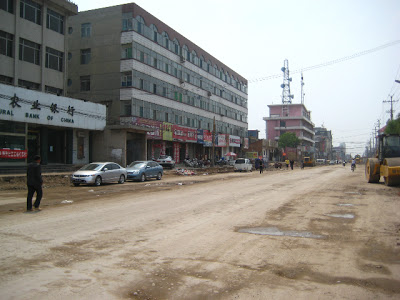
Taigu city in the midst of some much-needed road work in the spring of this year (photo courtesy of Sarah Hochendoner).

Nor is Taigu by any means a destination. For the most part, those who live here do so because their family lived here and their family did before that, and those who did not have the opportunity or the education to get out were forced to make a life for themselves here too. As this is largely an agricultural village, most people are farmers, and much of the land is studded with large swaths of field for tilling. The land that isn't is wrapped up in crumbling old-style pagodas interspersed with hastily-built concrete high-rises, all inlaid within a dirt and gravel road system that is constantly being paved and re-paved over. There is no shortage of small storefronts that line the streets and most any household or daily needs item can be acquired in town. As far as more epicurean amenities go, there is exactly one two-star hotel within county limits, a handful of fancy hot pot and buffet restaurants that we frequent on the weekends, and a newly-built department store complex—home to a full-fledged supermarket and a Dico's, China's fast-food answer to KFC. On the whole, though, Taigu is such a small town that it has no mention in Lonely Planet, does not appear on Google Maps, and is over an hour away from the nearest McDonald's.

Most students who come here do so more out of obligation and geographical convenience than choice. Their scores on their high school entrance examinations and—to a much-lesser degree—their own preference of universities are the sole mitigating factors in determining where they will spend their college years. For them, and for us as teachers, within the walled and gated complex of Shanxi Agricultural University (SAU) is where we spend the vast majority of our time. About 2km from the railway station in the center of town, SAU is divided into two halves—North Yard and South Yard. Where North Yard is home to faculty housing, the vegetable market, an elementary school, and a host of small shops and restaurants where we take our meals, South Yard comprises the meat of the campus—replete with student dormitories, athletic fields, showers, cafeterias, administrative offices, classrooms, and our own living quarters.

North Yard, home to a smorgasbord of street vendors, restaurants, hair salons, and clothing stores (photo courtesy of Alexandra Sterman).

In spite of what must come across as overwhelmingly foreign, I'm constantly amazed by just how many similarities I can draw between this little town and the place I've called home for four of the last five years of my life. Like the city of Oberlin, Taigu is a tiny rural town, and almost half of its population is reflected in the university student body. Walking around campus on any given day, it is impossible not to bump into people that you know—in my case now, mostly current or former students—who will occasionally stop to talk with you for minutes at a time. Privacy is at a premium, and just like at Oberlin, it feels as if your every move is being recorded and people are nose-deep in your business at all times. Activities are pretty tame by state school standards, and most of the fun has to be self-made. Oberlin and Taigu lie on almost exactly the same latitude, which makes the winters here just as crushingly depressing, and the springs that much more magically invigorating. While the temperature is similar, the difference in weather seems to lie in Taigu's incredible dryness and the fact that Oberlin isn't covered in a layer of russet Gobi Desert sand during the winter months.

In fact, in 1996, Oberlin and SAU had roughly the same number of students. Where Oberlin's population stayed relatively stable, SAU's skyrocketed to its current number of 10,000 under pressure from other Chinese universities to increase enrollment. By way of social activities, Taigu has a good selection of clubs and organizations for the under-stimulated and weekly movie screenings reminiscent of OFC, going so far as to project a select few onto the big screen in front of the old library as Mudd does in the spring. Geographically, it also matches up surprisingly well. Taigu is about 40 miles from the city of Taiyuan as Oberlin is from Cleveland, and though neither capital city engenders a very positive reputation nor offers much in the way of can't-miss entertainment, they sometimes seriously necessitate a visit all the same. Similarly, Taigu is about 450 miles from Beijing, the same distance that Oberlin is from New York City. Taigu might just be the only place where the night-life is actually more nonexistent than Oberlin's—outside of campus, the only thing open late are the sketchy massage parlors that double as brothels. Of course, most relevant of all is the over 100-year history of the Shansi program in Taigu, and the remnants of that cultural history being shared in both places.

But for all of my flack, there is actually a lot of good that comes with living in Taigu. Near the center of town, there is an old section with cobbled streets and traditional architecture not found in most other parts of China. As opposed to much of the city, the SAU campus is uncommonly beautiful, with trees and flowers lining most of the main roads. Being in a rural place instead of in a bigger city like Beijing allows me to discover that much more about myself—to see what makes me tick and where my passions lie without the distraction of external forces. And then there is the cost of living—by my own self-directed, non-scientific study, I would place Taigu food high in the running for cheapest in the world. As far as community goes, there are more foreign teachers at SAU than there are at any other school or university in all of Shanxi province. And there are some perks to living in near complete obscurity, even according to other Chinese people, who are hard-pressed to find Taigu on a map. In a year's time, I have never seen a foreigner here not accounted for, and I would estimate that in my lifetime, only a couple hundred non-Chinese will ever see this place first-hand. Most of all, there are so many interesting little nuggets about living in Taigu that I haven't ever explicitly detailed before.

As such, I've decided to devote myself to a new writing project, partially inspired by Brittany's “30 Days Experiment" in Indonesia, that I like to call “The Annals of Taigu.” Tomorrow is the start of November, and it gives me the opportunity to participate in NaBloPoMo, the blogging equivalent to National Novel Writing Month. Here's how it works: I write one blog post a day for the next month (or, at least until we start making travel plans for Thanksgiving), focusing on a single word or concept very relevant to my life here in Taigu. As a guideline, I am giving myself a cap of 600 words an entry, which serves a few purposes—one, to make my posts more readable for my audience, two, to give myself a manageable goal that I feel like I can complete, and three, to force my sometimes wayward writing into a more succinct format. As many of these posts will not undergo my standard editing treatment due to time constraints, I initially worried if I would be jeopardizing the quality of my writing in my strive toward quantity. Though this theory does hold water, I find it useful, and in some ways liberating to write in a more free-form manner, like writing a stream of consciousness monologue without worrying about who else might see it.

And thus, starting tomorrow, and continuing for at least the next 20 days, Taigu will be both your oyster and mine—to hold, to balk at, to savor, to put-down, to mock, and to cherish. Hope you enjoy the ride.

With Great Power Comes Greater Chance of Embarrassment

Taigu in the fall was like homecoming.  I had nary seen this place half as beautiful—hot, but not nearly as humid and muggy as my summer of travel had been, still warm enough for shorts in the daytime, clear with a crisp chill in the air at night.  It was coming home in the literal sense, of returning to China after a long, nearly one month bid in the Southeast Asian peninsula.  But it was also a very visceral homecoming, in the degree to which I care and feel connected to Tagiu with this past year—replete with struggle, challenge, and triumph of all stripes—now safely under my belt. 

Starting my second year, I feel like I'm looking at this place through a fresh set of eyes.  All the familiar sights and people seem newly animated.  Old students have been re-imagined—some as more distant acquaintances following the long break, and others, as full-blown friends without the “student” signifier.  Almost all of our favorite restaurants are still operational, but with such a long hiatus, they may as well be serving up dishes that we're trying for the first time.  With two new Fellows in tow, showing off this school has made me re-think and chronicle everything that I have learned over the past year.  It's as if I'm downloading all of my experiences onto a memory chip that can then be uploaded à la The Matrix into the minds of my contemporaries for faster processing.

But then there are those things that actually are different.  The man-made lake project that had just barely gotten off the ground last semester is now in full swing—though in a way I didn't expect.  It turns out that the lake project was scrapped in favor of what I can only describe as a “scenic area.”  The final design hints at a small, crescent moon-shaped stage in front of a plot of cement tiles, surely to be used for class photographs.  Behind it, the vice-president's house is obscured through the outstretched branches of tan oak trees and flora sprouting from a make-shift garden.  As my Chinese tutor Francis put it during one of our walking lessons, it looks like it could have been modeled after the Vietnam War Memorial in Washington, save for the giant tombstones listing off the names of the deceased.

The proposed site of the man-made lake project.  In typical Chinese fashion, plans tend to change at the last minute.

Construction crews now arrive daily to cart away wagon-loads of discarded earth and rubble, and are laying the concrete foundation for the base.  As such, the cafeteria where we used to take our lunches was finally demolished in the process, as was the filthy, but endearing AV room, where we had our last party of the year and, according to Taigu lore, had once been the site of actual classroom learning.  Nearby, another colony of shabbily-built row-houses has been wiped away to make room for a new parking lot, a testament to the rapidly-growing income rate of SAU faculty and students.  Still more, North Yard has seen a slight cosmetic makeover.  The streets have been widened to allow for greater ease of access, but don't try squeezing through there during the peak lunch and dinner hours—it's still as tight as a cattle car. 

In the cafeteria's place, we are now eating in the connected eave to Gerald's new house—a spiffy-looking kitchen and dining room ensemble that ironically looks like it came out of an Ikea catalog under the entry: “American diner.”  It's got a potted plant on the windowsill, off-white checker-print blinds on the windows, and a generally cheery interior, if you allow for the faux-wood veneering that lines the floor.  What's more, outside of prescribed lunches during the work-week, the spacious new kitchen gives us plenty of room to cook those larger, family-style meals on the weekends that we came to enjoy so much as a substitute for going out to eat.  Even my own modest living quarters got an upgrade this summer.  Unbeknownst to me, the Foreign Affairs Office replaced the outside screen door, gave my walls a fresh new layer of white-wash, and re-fastened the ceiling tiles so it doesn't feel like the roof is going to collapse at any moment.

Alexandra, one of the two new Fellows, posing with one of our daily lunches, prepared by the Office's do-it-all chef Rui Ping.

In the midst of all these changes, James and I have found ourselves in a new position of leadership—no longer wayward sheep herded indiscriminately by our own Senior Fellows, but this time the very shepherds ourselves, with a small flock at our beck-and-call.  It's been strangely empowering—this feeling of being the authority on a place.  Whereas one year ago, I knew close to nothing about Taigu and had to rely almost entirely on Nick and Anne to get around, I have been amazed at how fast I've been able to accrue information.  It feels like any new experience—“growing up” being the most obvious metaphor here—where within a few years time, you've outgrown crawling, blabbering incoherently, and spilling food all over yourself, to being able to walk, piece together strings of words into sentences, and, generally, limiting the amount of food that adorns your body.

I venture to contend that my growth and development in Taigu has been similarly profound.  I'm stealing a page out of Brittany's playbook here when I say this, but my authoritative knowledge on Taigu includes but is not limited to: singing Chinese karaoke songs at KTV, hosting amazing dance parties, buying train tickets to Beijing, locating the best public squat toilet when in a pinch, toasting everyone at a banquet without getting wasted, and refusing first-year students who want me to teach them English for free.  Not too shabby.  But I still can't take solace from the inscrutable musical fountain, escape being victim to the spontaneous whims of the Foreign Affairs Office, and outsmart the rats that insist on keeping me company on winter nights.  It's true what Brittany wrote, that, “once we reach a certain level of proficiency, it’s easier to see how far we are from the top instead of how far we have already come. But to those around us just starting off, we ARE the authority, just by having more tallied experience than the newcomer.”

So, what's it really like being the Senior Fellow?  Being in charge of going to dinner.  That, and generally making the decisions that effect what we as a group choose to do on a daily basis.  That's been no small adjustment especially when you consider my largely indecisive nature, but one that gets easier everyday.  Oh, and somewhere along the way, getting to the point where you understand things.  Like, for instance, about the way Taigu works—how to cope with the little surprises and disappointments that occupy each day, how everything seems to go wrong at the last minute, letting go of any claim to even the slightest shred of privacy or personal space, and how to interact with the people who populate this tiny town at the edge of the world.  Most exciting of all, I feel like my Chinese is finally reaching a pleasant state of proficiency.  Coming back to a place where I can communicate with people to a reasonable degree and feel like I can be a valuable and knowledgeable resource to the new Fellows has been a great blessing. 

But sometimes all the experience in the world isn't enough.  There have been countless occasions already where my perceived “expertise” has been put to the test and failed, leaving us at best, needing to change restaurants for lunch, and at worst, stranded in the capital city of Taiyuan for the night with no transportation to return home.  Aside from filling you with a bloated sense of assurance, being the “authority” makes you all the more acutely aware of the things you cannot do.  Sure, it's great that I can put money on my phone, but what good does it do to the new Fellows that I can't negotiate the terms of a new service plan without the help of a Chinese friend?  It's just like Uncle Ben said: “with greater power comes great responsibility.”  But little did he account for the grief and shame that his nephew faced when he wasn't always able save the world from evil—or in my case, from embarrassment.

It's been an interesting role-reversal.  When I talked with Anne last year about my lack of excitement regarding my second year and the new Fellows, she told me that one year prior she had felt the same way—that coming back to Taigu from a long summer holiday filled her with equal parts dread and anxiety, fear of what was to come, and disappointment at potentially not meeting her first year's expectations.  I was also nervous about retuning to Taigu, but for different reasons.  I was entirely ready to settle down into a routine again in the closest place to a single “home” I've had in over four years.  But I was anxious about how different that home would feel.  In Taigu, it's the people that make the place, and without Nick, Anne, and Dave, three friends who had been as close as siblings this past year, I had no idea how I would reconcile the weight of their absence.

When I first came to Taigu, I was panic-stricken by the thought that my core group of friends had shrunk from two or three dozen to as many strangers as I could count on a single hand.  No longer did I have the luxury of meeting up with friends who occupied more niche roles in my life—the friend I see movies with, or the friend I go running with, for example.  Now I would have to rely on every one new friend in Taigu to fulfill the role of three or four friends back home.  But I can safely say that with a year of experience under my belt, it's been working out shockingly well.  Aside from the usual drama that comes with our Big Brother-style living arrangements, and that fact that we may as well be six strangers marooned on a desert island with a film crew and a captivated international audience scrutinizing over our every move, things have been good. 

It also doesn't hurt that two of the six foreigners from last year are still with me in Taigu now.  Living with James and Gerald has been an enormous comfort, and one that I am not taking for granted.  The new Fellows have delighted in comparing my relationship with James to that of The Odd Couple's Oscar and Felix (I'll let you guess which is which).  Our every-day interactions take on something close to that of a married couple—James will insist on buying new things for the house that I deem as costly and unnecessary, and I'll ask him to clear out his books and papers from the living room every time we have guests over.  Our new regime is a decidedly benevolent one, and compared to last year's world order, we've certainly cut down on the drinking and partying culture, which, banquets aside, has probably shrunk to about a tenth of where it was this time last October.  What's more, I am lucky that the new Fellows have been so great and interesting thus far and I'm excited to continue to get to know them better.

Life in Taigu sort of feels like freshmen year at Oberlin.  You travel in a pack, take your meals together with the rest of your hall, and feel like you are constantly inundated with people.  It's as if you have been sucked into a bubble without any control over your own life, the decisions that you make, or the choice to individual freedoms.  It can be alarming to those on the outside, but like with any new community, it is critical to build a strong foundation in order to ensure group harmony in the long run when everyone eventually branches out on their own.  And that harmony starts at home.  Whereas last year, I found myself spending a great deal of my free time at Nick and Anne's house, I'm finding that my house is now becoming the central congregating space for the usual slew of social activities that keep Taigu bearable.  As might be expected, we can't help talking about last year—the stories and the memories that comprise our shared friendship.  But more even than the past, we're all looking forward to the hope for many more new stories in the year to come.

Perhaps the biggest change of all this year is that this time around, I have an idea of what to expect.  Though part of me knows that everything will be different, at least I can say that I have experienced a winter in Taigu, caught a student cheating on his homework, or gone without water and electricity during a blackout.  Teaching is easier in general because I have already accrued an inventory of successful lesson plans with which I can mine for my new classes.  Now, it's just a matter of believing in my abilities to make it through the year.  I'll end with this metaphor.  Walking alone at night, I no longer feel trepidation or anxiety over the darkness of Taigu's rural countryside.  Even if I can't see anything, I can still tell where I'm going because the surfaces feel different—smooth tar roads converge with narrow pebble tracks, and diamond-shaped stencils line safe markers in the grass.  I let my feet guide me—putting my mind to rest—and trust my instincts and my confidence to navigate those uncertain paths back to safety.

Lessons Gleaned from Student Mugshots

Last week was our first week of class.  And like I did with my first crop of students last year, the first day saw me playing host to a Q&A session from my students.  First, I had them give a self-introduction, then helped them choose an English name. Afterward, I made them pose with said names for a photo to allow me to connect their new names with their faces more easily.  Then came the panel discussion where the topic felt more than a bit self-serving.  More often than not, the questions were not particularly beguiling—most revolved around my perceived differences between America and China, whether I liked the taste of Chinese food, some general details about my academic and personal background, where I've been in China and abroad, whether I've adjusted to life at the university, and if I'm able to eat with chopsticks. 

But every now and then, your students will surprise you.  If nothing else, their questions, in conjunction with their mugshots, gave me more insight into their collective psyche.  I don't consider myself much of a portrait photographer, but these are a sampling of some of the most interesting.


This month I am temporarily teaching two additional classes as a substitute for the final foreign teacher who is expected to arrive in Taigu sometime in October.  Their English level is on the whole not as good as that of my regular students, but the Office was desperate, and I'm getting paid a hefty bonus to do it.  Both classes were previously Gerald's, some of whom I knew only in the context of dance parties and social gatherings last year.  They seemed to remember me just as well.


What never fails to go unasked in each of my classes is the classic, “do you have a girlfriend?” question, to which I respond with, “it's a secret,” to mild irritation and fits of laughter.  However, with my first class I made the mistake of saying that I would tell them later.  Virginia, one of the feistiest and most free-thinking students in the class, asked me again before I dismissed class, “so, are you or are you not available?”  I had to tell her the truth.


What amazed me was how differently each student reacted to my impromptu photo shoot.  Since this was the first criterion with which I could use to judge them, I figured that most students would want to make a good impression.  But where some smiled brightly and struck a pose, just as many were shy, gawky, or merely devoid of life.  To put it simply, some treated it like a birthday still, others, like they had waited for six hours at the DMV, and still more, like they were posing for their middle school yearbook photo.


A lesson on name choosing: Candy is not a stripper name.  Neither is Cherry, Angel, Lotus, Snow, or Sky.  Spring is a boy's name.  As are Breath, Caitlin, and Dandelion.  Obama is a mild-mannered sophomore who sits in the back of the class and doodles on his homework.  Salt, Water, Rock, and Sea, are no longer strictly elements of the natural world.  Never underestimate the power of a student's imagination.


What struck me most about Monet was not the way he looked or carried himself, and certainly not his English level (which was nearly non-existent), but the style that he seemed to exude.  It was no surprise then to discover that he was an art major, the first of any student I've taught.  He studied drawing and painting as an undergrad and wanted a name to suit his personality.  And thus Monet was born.


“This woman in the picture, is that your—”
“Yes, that's my mother.”
(Collective intake of breath.)
“But she looks Chinese.”
“She is Chinese.”
(Collective gasp.)
“And that old man hugging you in the other picture—”
“He's my father.”
“So you're—”
“Half-Chinese and half-American.”
(Excited whispers and applause.)
“Oh.” (Beat.) “Your mother is very pretty.”


One student refused to have his picture taken in conjunction with his name, sighting the generally unsavory connection between a picture of a student holding a name placard and the mugshots of hardened criminals from American movies he had seen.  At his request, I allowed him to take his picture without it.


Never let your approval for the name “Apple” be overstated.  Then you might have three or four of her neighboring classmates all vying for the names of other fruits, with one of them sorely mouthing in Chinese that she had wanted to be Apple all along before some girl stole it from under her.  “Peach,” evidently, is not pleasing to the ear.  But “Grape” is.  Go figure.


One student asked me, “if there were only two girls left in the world—a Chinese girl and a Japanese girl—which one would you choose?”  It was supposed to play on the negative opinion our students generally hold of their neighbors to the east, but I was too smart to bite.  Both, I thought to myself.  After all, I have to repopulate the Earth.